How much does a nido cost?
Reference budget for a 50 m² house in guadua and bahareque · October 2026 prices
What it costs to build the 50 m² prototype, item by item, and how much less cash is needed when the farm supplies the guadua and the earth and the minga supplies the hands.
In short
These are reference figures, not a quote: every farm, every access road and every soil changes the number. They are useful for three things: knowing how much needs to be raised per house, deciding what the family can contribute, and taking a list to the hardware store.
What is included and what is not
Included: concrete foundation and plinth, treated guadua frame, earth bahareque walls with mats on both faces, plaster and limewash, clay tile roof with gutters, concrete floor, wooden doors and windows, porch railing, bathroom and kitchen with a septic system, electrical wiring and a 1,000 W solar kit, transport to the vereda, tools, plans signed by an engineer, permit and 8 % contingency.
Not included: the land, the access road, a grid connection (where available), furniture, or the wide porch and the artists' finishes of the «decorate and live in it» phase.
How it was calculated
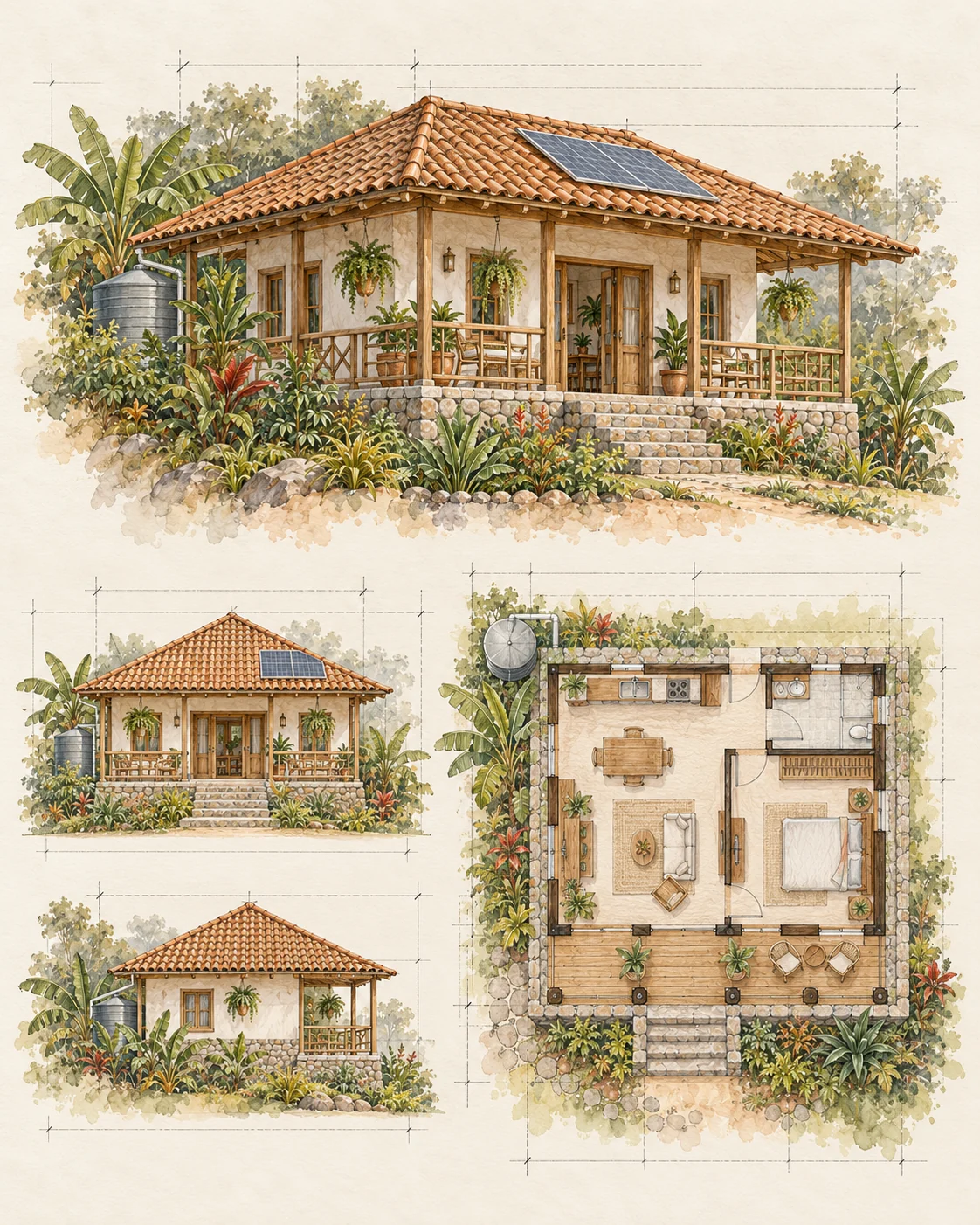
Geometry of this budget: the quantities below correspond to the 10 × 5 m exercise with a gable roof. The new structure guide explores 6.25 × 8 m, with 50 m² including the porch and a hip roof; that study does not yet have recalculated quantities in this budget.
- The quantities come from our own quantity take-off for a 10 × 5 m floor plan, 2.4 m walls (44 metres of wall, 95 m² net) and a gable roof with 60 cm eaves (75 m²), using the per-metre wall output rates of Universidad de los Andes (2002, with Construdata), the foundation table of the Colombian Association for Earthquake Engineering manual (2001), the rules of Title E of the NSR-10 building code and a rural budget by UNAD (2026) for the installations. In total, about 110 guadua culms, 290 m² of mats, 2,360 tiles and 145 working days.
- The prices are from Homecenter Colombia and from treated-guadua suppliers in the Valle del Cauca, checked in October 2026, without delivery. Where there is no public price (bulk sand, dump-truck loads, wooden windows, labour), an estimate is used and marked as such.
- Labour. The foundation and the floor slab are priced per task, using the real quote from House 1's master builder (Pijao, September 2026): excavation at $40,000 per metre, footings at $90,000, tie beam at $55,000 per metre and floor slab at $18,000 per m². It is the same work in a nido. Everything else (guadua, bahareque, roof, carpentry, installations) is paid by the day: the helper at the 2026 legal floor (minimum wage plus transport allowance, $66,700) and the skilled builder at $110,000, what master builders in Pijao charge (between $80,000 and $150,000, most between $100,000 and $120,000).
- Two scenarios. In the first, everything is bought and all labour is paid. In the second, the farm supplies the guadua, the mats, the earth, the straw and the cow dung, and the minga supplies the helpers' days and about 40 % of the work contracted per task. That removes materials but adds work: cutting, treating and drying about 215 culms, making the mats and treading the mud add 45 working days, and the chemicals, the soaking tank and the minga's sancocho still have to be paid for.
The guide to foundations and floors compares other foundation, floor support and finish options. It does not change these quantities or price those alternatives: choosing them requires a review of the ground conditions and design.
The budget
What weighs most, and how to lower it
- The clay tile is the most expensive line in purchased materials, about $6 million. Tiles salvaged from demolished houses bring it down a lot; a zinc sheet roof would cost about $1 million, but the house ends up hotter and noisier (see clay tile).
- The solar kit ($4.6 million) is unnecessary where the power grid reaches.
- The septic system ($1.9 million) cannot be cut: it is health.
- Cement and aggregates total around COP $4 million for foundations and floors. Any use of stone from the farm must be approved in the design; it does not automatically replace reinforcement or foundations. Some finishes can be scheduled later if the floor is safe, dry and usable from the outset.
- What the farm supplies is worth about $12 million: guadua, mats, earth, straw and cow dung. It is the biggest contribution a family can make, and the one that takes the most work.
What doesn't show on the list
- The permit. Cutting guadua from a natural stand, even your own, requires authorisation from the CRQ (the regional environmental authority). For stands of up to one hectare, the CRQ does the study. It takes weeks: request it before starting.
- The time. With a crew of two skilled builders and two helpers, about eight working weeks. With weekend mingas, several months.
- Supervision. The minga saves working days, not judgement: a skilled builder who knows guadua and an engineer who checks the structure cannot be replaced.
- The food. Twenty minga sancochos cost more than $2 million. One Pot, One Roof exists for exactly that.
For comparison
| Reference | Figure |
|---|---|
| House 1 · Las Golondrinas (real, under construction) | A brick-and-mortar house of about 64 m², with the materials already bought: the master builder quoted all the labour at $14.9 million. It is not a bahareque nido, but it gives the real price of work in Pijao |
| Guadua builder in Quindío, 2025–2026 | From $550,000 per m² for the shell and from $850,000 finished: for 50 m², $27 to $43 million |
| New rural housing subsidy, 2026 | Up to 70 monthly minimum wages: $122.6 million, for a house of at least 50 m² |
| Steel-and-sheet houses delivered after the earthquake (Grupo Argos, 2026) | 43 m² for about $90 million; 59 m² for $100 to $110 million |
| Urban social housing, 2026 | $1.8 to $2.2 million per m² (Camacol and DANE) |
In cash, a guadua-and-earth nido costs between a half and a third of an industrialised house of the same size, and it keeps the money and the craft in the region.
Sources and contributors
- Prices: Homecenter Colombia and Guadua Bamboo SAS, October 2026; Autosolar Colombia for the solar kit.
- 2026 minimum wage: Decrees 1469 and 1470 of 2025.
- Quantities and output rates: Universidad de los Andes, economic analysis of housing in cement-rendered bahareque (2002); AIS, Earthquake-resistant construction manual for cement-rendered bahareque housing (2001); NSR-10, Title E.
- Rural subsidy: Resolution 536 of 2020, Ministry of Housing, via Camacol.
- Market references: guadua builder, 2025–2026 rates; Grupo Argos, houses after the earthquake; cost per m² in 2026.
- Own guadua: Resolution 1740 of 2016.
Written by the AHO! team. The full list, with a source and date for each item, is in nido/data/precios.json and can be downloaded above. It still has to be validated with quotes in Armenia and Calarcá and with the alliance's master builders.
Related (in Spanish)
NIDO foundations and floors The NIDO structure Guadua Treating and drying guadua Foundation and damp Bahareque Earth plasters Clay tile The porch
Something to correct or add? Saber Vivo is written with the people who know. Write to us or tell us at the next minga.
You may freely copy, print and share this page, citing «Saber Vivo · Nido Alliance». It is a guide to shared knowledge: it does not replace the judgement of a master builder, an engineer or a health professional.